
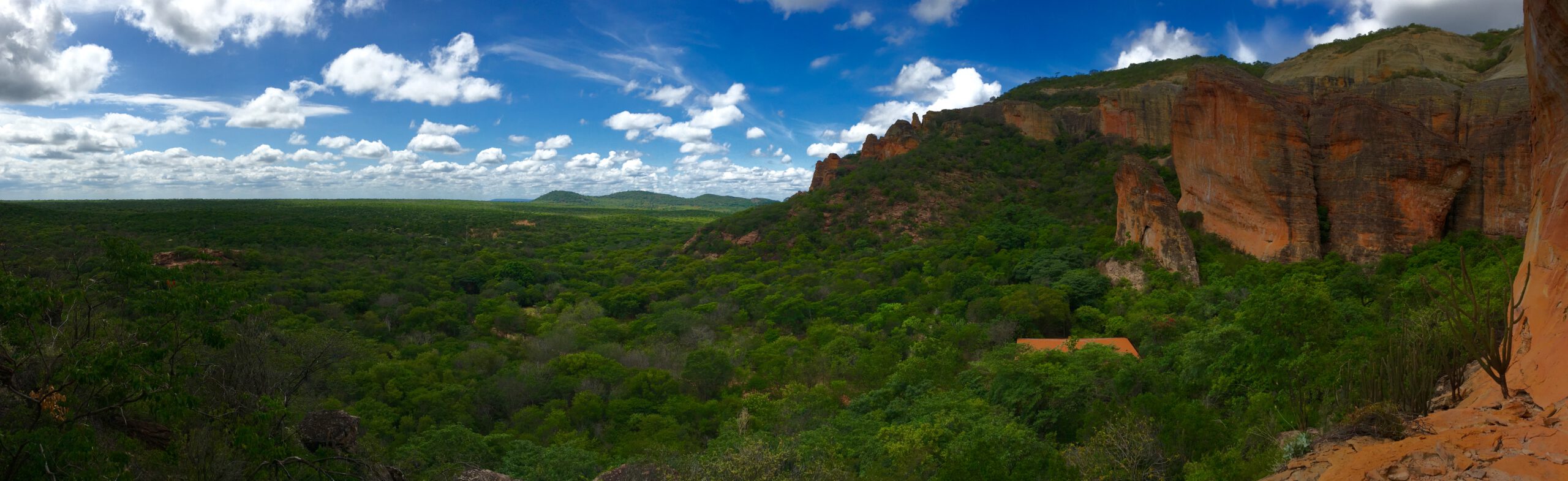
Serra da Capivara National Park was created in 1979 and is a UNESCO World Heritage site, widely known for its rock art and early human prehistoric occupation.
Located in the southeast of the State of Piauí at the municipalities of São Raimundo Nonato, João Costa, Brejo do Piauí, and Coronel José Dias, the park has an area of approximately 130 thousand hectares. It is also one of few preservation areas in the Caatinga environment, a savanna-like environment unique to Brazil.
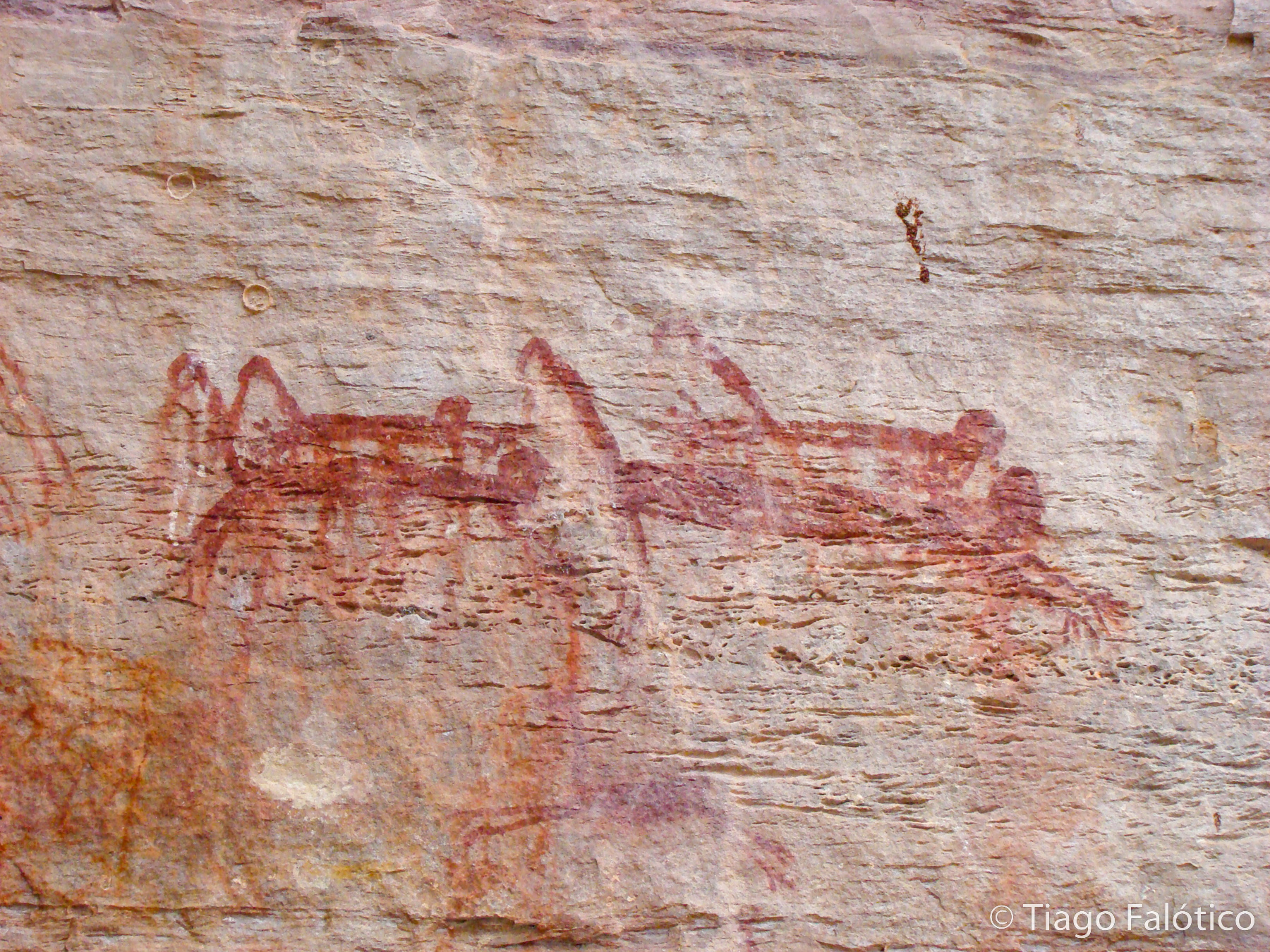
Serra da Capivara is a remarkable archaeological site, offering a fascinating glimpse into the history of one of South America’s earliest human occupations. With over 300 archaeological sites discovered within the park, including rock paintings dating back 20,000 years (or more), the park is truly a testament to our ancient past. With a rich fauna, the place has around 47 species of lizards, 52 species of snakes, 48 amphibians, 57 mammals, and 510 species of birds. The park is home to three primate species, marmosets (Callithrix jacchus), howler monkeys (Alouatta caraya), and bearded capuchin monkeys (Sapajus libidinosus).
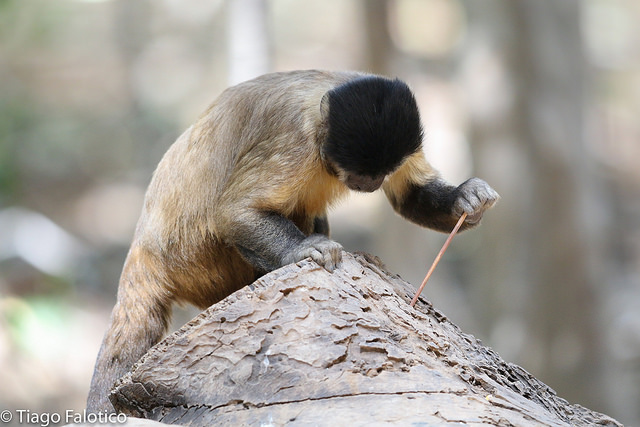
The capuchin monkeys that inhabit the park are very particular. They have been studied for 20 years and are known to have the most diverse toolkit compared to other capuchin populations.
During these decades of research, our member, Tiago Falótico, observed and described important details and nuances of how these capuchins manufacture, manipulate, and use their tools.
It was possible to observe how the monkeys used stone tools to process cashew nuts, avoiding the caustic substance inside the nuts, as well as the use of stone tools for digging for roots, tubers, and trapdoor spiders. For each type of use, the capuchins choose different sizes and shapes of stones. This is also the most terrestrial capuchin population known to date, a factor that can have influenced the diversity of tools they use.

For a long time this was also the only population where the monkeys were observed to use sticks to forage and hunt small vertebrates. This is an activity only done by males! This sexual bias on probe tool use was also observed in naturalistic experiments and later in the only other population where capuchins were also observed doing this behavior
Another peculiar and sexually biased behavior is executed only by females. During the oestrus period, the females of one of our study groups throw small pebbles directed at the males as part of their sexual display during the courtship.
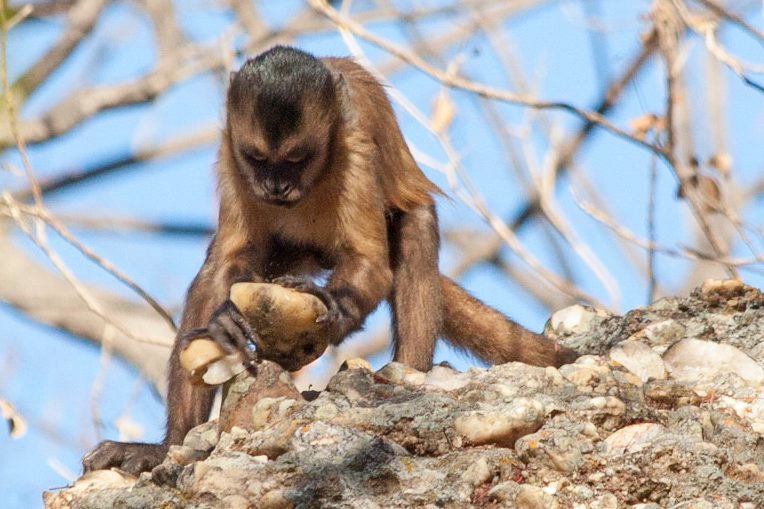
The monkeys in this population also perform a unique behavior: pound stones against stones (which unintentionally creates “flakes”). This behavior also produces a powder that can be sniffed or ingested. In collaboration with archaeologists from the University of Oxford and Max Planck Institute for Evolutionary Anthropology, it was possible to determine that these flakes resemble humans’ olduvai flakes. Primate archaeology excavations at Serra da Capivara found capuchin stone tools dating up to 3000 years, demonstrating that this stone tool-using behavior has been present in this population for a long period!

Research on the development of tool-use behavior and social learning has also been conducted with Serra da Capivara capuchins. Recently, our member Henrique Rufo was doing his doctorate research on the ontogeny and social learning mechanisms of the digging stone tool behavior.
In 2024 we began to build here our new field base to support the long-term reserach on this population.
Groups
The main group we follow in Serra da Capivara is the Pedra Furada group. This group has been followed by our researchers since 2007, but we also encounter other groups. Below you can see the current individuals from some of those groups
- Pedra Furada
- Mutilados (a fission from Pedra Furada group)
- Mínimo
- Sansão
References:
- Fundação Museu do Homem Americano
- Arroyo, A., Falótico, T., Burguet-Coca, A., Expósito, I., Quinn, P., & Proffitt, T. (2021). Use-wear and residue analysis of pounding tools used by wild capuchin monkeys (Sapajus libidinosus) from Serra da Capivara (Piauí, Brazil). Journal of Archaeological Science: Report, 35, 102690. https://doi.org/10.1016/j.jasrep.2020.102690
- Falótico, T. (2023). Vertebrate predation and tool-aided capture of prey by savannah wild capuchin monkeys (Sapajus libidinosus). International Journal of Primatology, 44(1), 9–20. https://doi.org/10.1007/s10764-022-00320-z
- Falótico, T., Bueno, C. Q., & Ottoni, E. B. (2021). Ontogeny and sex differences in object manipulation and probe tool use by wild tufted capuchin monkeys (Sapajus libidinosus). American Journal of Primatology, 83(5), e23251. https://doi.org/10.1002/ajp.23251
- Falótico, T., Inaba, A., McGrew, W. C., & Ottoni, E. B. (2016). Vertical bipedal locomotion in wild bearded capuchin monkeys (Sapajus libidinosus). Primates, 57(4), 533–540. https://doi.org/10.1007/s10329-016-0542-2
- Falótico, T., Luncz, L. V., Svensson, M. S., & Haslam, M. (2016). Cashew nut positioning during stone tool use by wild bearded capuchin monkeys (Sapajus libidinosus). Folia Primatologica, 87(6), 392–397. https://doi.org/10.1159/000459621
- Falótico, T., Mendonça-Furtado, O., Fogaça, M. D., Tokuda, M., Ottoni, E. B., & Verderane, M. P. (2021). Wild robust capuchin monkey interactions with sympatric primates. Primates, 62(4), 659–666. https://doi.org/10.1007/s10329-021-00913-x
- Falótico, T., & Ottoni, E. B. (2013). Stone throwing as a sexual display in wild female bearded capuchin monkeys, Sapajus libidinosus. PLoS ONE, 8(11), e79535. https://doi.org/10.1371/journal.pone.0079535
- Falótico, T., & Ottoni, E. B. (2014). Sexual bias in probe tool manufacture and use by wild bearded capuchin monkeys. Behavioural Processes, 108, 117–122. https://doi.org/10.1016/j.beproc.2014.09.036
- Falótico, T., & Ottoni, E. B. (2016). The manifold use of pounding stone tools by wild capuchin monkeys of Serra da Capivara National Park, Brazil. Behaviour, 153(4), 421–442. https://doi.org/10.1163/1568539x-00003357
- Falótico, T., & Ottoni, E. B. (2023). Greater tool use diversity is associated with increased terrestriality in wild capuchin monkeys. American Journal of Biological Anthropology, 181(2), 312–317. https://doi.org/10.1002/ajpa.24740
- Falótico, T., Proffitt, T., Ottoni, E. B., Staff, R. A., & Haslam, M. (2019). Three thousand years of wild capuchin stone tool use. Nature Ecology & Evolution, 3(7), 1034–1038. https://doi.org/10.1038/s41559-019-0904-4
- Falótico, T., Siqueira, J. O., & Ottoni, E. B. (2017). Digging up food: excavation stone tool use by wild capuchin monkeys. Scientific Reports, 7(1), 6278. https://doi.org/10.1038/s41598-017-06541-0
- Falótico, T., Verderane, M. P., Mendonça-Furtado, O., Spagnoletti, N., Ottoni, E. B., Visalberghi, E., & Izar, P. (2018). Food or threat? Wild capuchin monkeys (Sapajus libidinosus) as both predators and prey of snakes. Primates, 59(1), 99–106. https://doi.org/10.1007/s10329-017-0631-x
- Haslam, M., & Falótico, T. (2015). Nasal probe and toothpick tool use by a wild female bearded capuchin (Sapajus libidinosus). Primates, 56(3), 211–214. https://doi.org/10.1007/s10329-015-0470-6
- Haslam, M., Luncz, L. V., Staff, R. A., Bradshaw, F., Ottoni, E. B., & Falótico, T. (2016). Pre-Columbian monkey tools. Current Biology, 26(13), R521–R522. https://doi.org/10.1016/j.cub.2016.05.046
- Luncz, L. V., Falótico, T., Pascual-Garrido, A., Corat, C., Mosley, H., & Haslam, M. (2016). Wild capuchin monkeys adjust stone tools according to changing nut properties. Scientific Reports, 6(1), 33089. https://doi.org/10.1038/srep33089
- Proffitt, T., Luncz, L. V., Falótico, T., Ottoni, E. B., Torre, I. de la, & Haslam, M. (2016). Wild monkeys flake stone tools. Nature, 539(7627), 85–88. https://doi.org/10.1038/nature20112