
This project began in 2018 with the goal of understanding and identifying the cultural behavior of the capuchin monkey, a neotropical primate. This intelligent and curious monkey exhibits several behaviors, including tool use, that are similar to those of our ancestors, despite a 40-million-year evolutionary history separating them. That makes capuchins an interesting alternative model to understand human evolution.
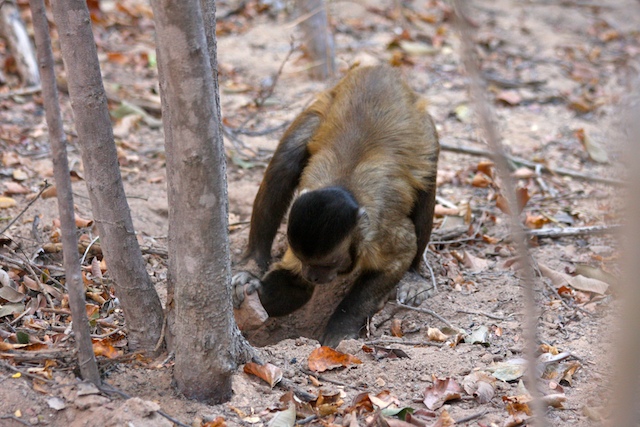
Adult male capuchin monkey using a stone to dig for roots. 
Nut-cracking with macauba remains at Ubajara National Park. 
Adult capuchin monkey cracking macauba palm nut at Ubajara National Park. 
Capuchin monkey fragmenting a hammerstone while doing stone-on-stone behavior at Serra da Capivara National Park. 
Infant observing his mother using a hammerstone at Serra da Capivara National Park. 
Adult male inspecting a hole in the ground in an experimental setting at Ubajara National Park. 
Capuchin monkey cracking a macaúba with a hammerstone at Ubajara National Park. 
Capuchin monkey interacting with experimental apparatus at Chapada dos Veadeiros National Park 
Adult male capuchin monkey using a heavy hammerstone (>7kg) at Chapada dos Veadeiros National Park. 
Capuchin monkey eating a jatobá fruit at Chapada dos Veadeiros National Park. 
Detail of a capuchin striking a palm nut with a hammerstone. Tietê Ecological Park. 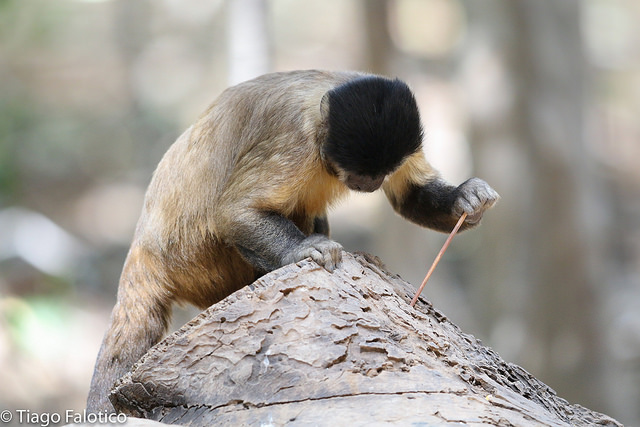
Capuchin monkey using a stick probe tool. Serra da Capivara National Park – Brazil 
Adult male capuchin monkey cracking a cashew nut. Serra da Capivara National Park. 
Capuchin monkey cracking a palm nut using a hammerstone at Tietê Ecological Park.
The project brought together a team of international researchers from different areas of expertise. Primatologists, geneticists, archaeologists, botanists, and biologists collaborate to understand why capuchin monkey populations exhibit such distinct behaviors, despite living in similar environments.

The project’s first phase had the support of the São Paulo Research Foundation (FAPESP), National Geographic Society, and Leakey Foundation, and was based at the School of Arts, Sciences and Humanities at the University of São Paulo.
In this first phase, we mapped eight populations of robust capuchin monkeys and identified tool-use behaviors in these new populations.
In 2024, the project was selected as part of the new Wildlife Intelligence Project, funded by the National Geographic Society and Templeton World Charity Foundation, as an initiative to support research on animal intelligence.

The project is now based at Neoprego and will set up long-term research bases at Serra da Capivara and Ubajara.
Aims
The current project phase aims to compare two (and potentially more) populations of capuchin monkeys to understand the diversity in tool use behavior and other behaviors, as well as the factors affecting the presence, variance, and development of these behaviors. We will collect data to study ontogeny and proximate factors affecting probe tool use and its sex bias. We also aim to understand the “flake” production associated with certain stone tool-use behaviors and utilize this knowledge to discuss the emergence of flake production in the human lineage.
Main questions
- Are ecological factors the main ones leading to the tool use differences?
- Is there a significant genetic difference between the populations? Can it explain some of the variations in tool use?
- Which tool-use behaviors could be cultural traits?
- Is cultural diversity the same between populations?
- How are the capuchin “flakes” created, and are they different between populations?
- How long did stone tool use and flake production by capuchins occur in each population?
- How is the development of probe tool use behavior in those populations?
- Is probe tool use behavior sex bias linked to low food return?
People
The project is composed of a highly trained team of scientists from diverse backgrounds, coming together to study this topic, some of whom are also members of Neoprego.
PRINCIPAL INVESTIGATOR
DR. TIAGO FALÓTICO 

Tiago is a biologist, ethologist and primatologist. He is a National Geographic Explorer and one of the founders of the NGO Neotropical Primates Research Group (Neoprego).
He has studied wild capuchin monkeys and other primates for over 20 years and is now leading the long-term CapCult project. His studies of capuchin monkeys at Serra da Capivara National Park were the starting point for this project. This population exhibits the most complex and diverse tool-use behavior among capuchin monkeys known to date, and it serves as the initial comparison for the other study sites in the project.
RESEARCHERS
PROF. DR. MARIA CÁTIRA BORTOLINI

Biologist and geneticist with great experience in populations genetic diversity, genomic ancestrality and peopling of the Americas. She is a full professor at Rio Grande do Sul Federal University. Her team will study the genetic variance between and within the study populations.
DR. TOMOS PROFFITT

Tom is a Palaeolithic archaeologist with a background in lithic analysis, GIS analysis, and experimental archaeology. He runs and conducts archaeological fieldwork in various parts of the globe. He is interested in exploring diachronic and synchronic variations in lithic assemblages within the Palaeolithic archaeological record to better understand early hominin technology, technical expertise, and land-use patterns.
Additionally, since 2016, he has been involved in developing the new field of primate archaeology. He is especially interested in fields of primate tool use and early hominin percussive technology. He currently conducts long-term capuchin primate archaeology fieldwork in Serra da Capivara National Park in Brazil, focusing on understanding the archaeological signature of capuchin stone tool use.
Dr. TATIANE VALENÇA

Tati Valença is a biologist, ethologist, and primatologist. She has a Master’s in Animal Behavior and is a doctoral student at the University of São Paulo. Her broad interests include ecology and the conservation of animal culture.
She began studying capuchin monkeys in 2013 during her undergraduate studies. She has been part of the CapCult Project since its inception, working as a technician in 2019/2020, where she collected and analyzed behavioral and ecological data at several field sites. Since 2020, she has been studying the bearded capuchin monkeys of Ubajara National Park in more detail, describing their tool use repertoire and investigating the role of terrestriality in tool use.
STUDENTS
MSC. HENRIQUE PEREIRA RUFO

Henrique is a biologist and primatologist with research in Animal Behavior, focusing on tool use and social learning in capuchin monkeys. During his master’s degree in Experimental Psychology at the University of São Paulo (USP), he developed research with an experimental task focused on the innovative use of stick tools and the social learning mechanisms involved in the diffusion of the task solution. Henrique is currently a doctoral student in the same department, researching the ontogeny and social learning of stone tool use for digging by capuchin monkeys at Serra da Capivara National Park, Piauí. He also has an interest in animal culture and comparative studies.
BSC. GABRIELA DE OLIVEIRA AFFONÇO

Gabriela is a biologist who worked as a research assistant in 2022/2023, collecting behavioral data on tool use by bearded capuchins in Ubajara National Park. She is currently a master’s student at the Museum of Archaeology and Ethnology of the University of São Paulo, where she is studying lithic fragments of capuchin monkey tools from the Ubajara National Park and Serra da Capivara National Park. This study encompasses morphological and technological analyses of the objects, as well as biomechanical analyses of nut-cracking and stone-on-stone behaviors.
ALUMNI
People who contributed to the project in past years.
- Amanda Christina Macedo
- Andrews Michel F. Oliveira Nunes
- Beatriz Cabrera Santana
- Giulia Sirianni
- Guilherme Henrique Mugnaini
- Luiza Gonzalez Ferreira
- Mariana D. Fogaça
- Matheus Albertin De Jesus
- Michele P. Verderane
- Paulo Henrique M. Coutinho
- Tatiana Espinola
- Vivian Heloise Tavares de Sousa
Publications and outcomes
The outcomes of this project are listed in the Publications page.
Grants
This project is currently funded by:


Previous project funders included São Paulo Research Foundation (FAPESP), The Leakey Foundation, and Marie Skłodowska-Curie Actions.